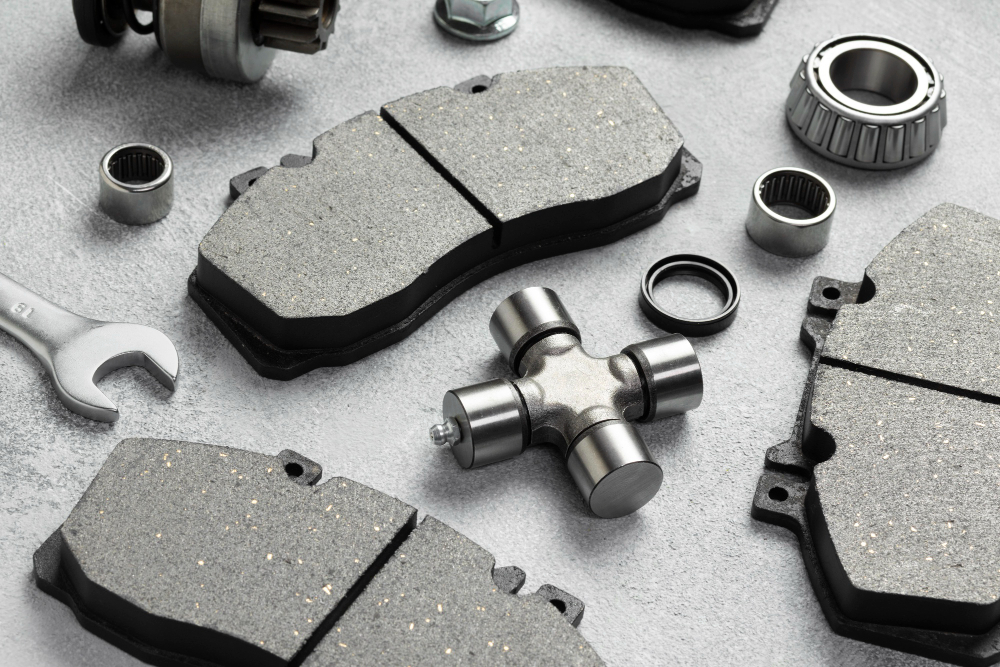
The braking system is one of the key components of a vehicle. The safety of all road users depends on its proper functioning. The main purpose of this part is to create maximum friction at the point of contact between the pad and the disc. When the driver presses the brake pedal, the pads press against the disc, and the car gradually reduces speed until it comes to a complete stop. However, during operation, even original pads often wear out. It is best to replace them immediately — our car service center in Warsaw, RemZone, can help you with this. Before visiting the service, the vehicle owner should determine which brake pads are needed.
Types of Brake Pads and Their Features
By design, brake pads can be disc or drum. The first type is installed on almost all modern cars, while the second is found in older foreign vehicles.
Based on the manufacturing material, brake pads can be organic. They contain metal shavings and organic components (glass, carbon, Kevlar). These are more expensive, but the price is fully justified by their quality. They are highly heat-resistant and have reduced wear. They respond instantly to pedal pressure and operate almost silently. This type is suitable for cars intended for calm, steady driving.
Metallic brake pads offer nearly 100% efficiency. They withstand high temperatures but produce a lot of noise during operation. They are commonly used in racing cars but are sometimes installed in everyday vehicles.
Semi-metallic pads contain a mixture of metals. Their production often uses both ferrous and non-ferrous metals. They are considered an ideal option in terms of price and quality. They are durable and reliable but may lose efficiency at low temperatures.
Ceramic and semi-ceramic pads are made from a combination of ceramic materials, metal, and synthetic rubber. These brakes operate almost silently, are reliable, and slightly more expensive.
Depending on the position, brake pads are classified as front or rear. The main difference between them is the level of load. The front axle always carries more load than the rear. This means that front pads should be chosen to be more durable and reliable.
What to Look For When Choosing Quality Brake Pads?
One of the most important parameters that influence your choice is the coefficient of friction. The values can be found on the product packaging.
There are three categories:
- First category (0.35–0.50) – original pads supplied to manufacturing plants. They are often referred to as “OEM conveyor pads.” They are not easy to find for retail purchase, and their price is quite high.
- Second category (0.35–0.25) – aftermarket analogs. These are not original parts, but they are perfectly suitable as replacements for factory pads. They are reliable and long-lasting.
- Third category (below 0.25) – this value cannot ensure proper braking. The price may be attractive, but buying such pads is pointless.
Another important parameter affecting braking quality is the service life until maximum wear. For original parts, it is usually between 15,000 and 60,000 kilometers, while analogs last about 10,000–13,000 kilometers.
How to Know It’s Time for a Replacement?
Even expensive, high-quality parts wear out over time. Therefore, it’s important to replace brake pads promptly before the braking system fails. You can determine that the time has come by the following signs: a distinct squeaking or grinding noise during braking, an increased braking distance, or uneven wear of the brake disc.
Specialists at our service center recommend checking the pads at least once every 20,000 kilometers. Much depends on your driving style. If you tend to drive aggressively, it’s better to inspect the brakes more frequently.