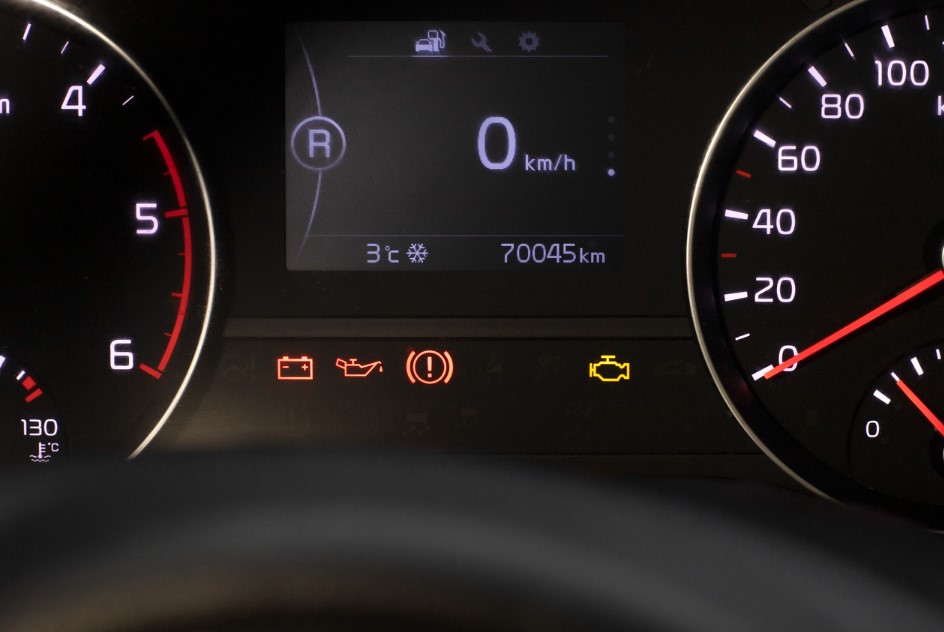
Every driver has seen the Check Engine light on the car dashboard at least once in their life. This small orange indicator lights up when the electronic control unit detects a malfunction in the engine or other critical systems (fuel, exhaust, ignition). The warning does not always signal a disaster – sometimes it only indicates minor irregularities. However, ignoring it and continuing to drive in this state is not safe. The best approach is to go to a car service in Warsaw immediately, where specialists can explain the problem and help fix it. Below, we provide a brief overview of the main reasons for the Check Engine light and how to address them, based on our service’s practical experience.
Why Does the Check Engine Light Come On?
There are dozens of factors that can trigger the indicator. We will focus on the ones we encounter most often in our work.
The Check Engine light may turn on due to a loosely closed fuel cap, poor-quality fuel, low oil level, or oil leaks. This happens because fuel does not reach the engine in the proper amount, for example, due to a faulty pump. Spark plugs may fail, or fuel injectors may become clogged. In one cylinder, there may be no spark, or the catalytic converter may be malfunctioning.
During service checks, faulty MAF, MAP, or TPS sensors are often detected, which leads to incorrect fuel preparation and ECU errors. Problems with the EGR system, responsible for reducing emissions, are also common – it may jam due to carbon buildup, causing the Check Engine light to illuminate and the engine to run irregularly.
Types of Indication
Before taking action, it’s important to understand how the indicator is behaving. If it is steady, it signals a non-critical error. If it is flashing, the situation is serious. In the latter case, the engine often runs unevenly, loses power, and continuing to drive may be dangerous. If the light flashes, stop driving immediately to assess the situation.
Step-by-Step Instructions: What to Do When the Check Engine Light Comes On
- Assess the car’s condition – Are there vibrations, power loss, unusual noises, the smell of fuel, or smoke? If the indicator is on but the engine is running normally, you can drive to the nearest service center. Drive smoothly, avoid sudden revs, keep speed low, and monitor other indicators. If the engine misfires, loses power, or emits smoke, call a tow truck.
- Check for simple causes – Inspect the fuel cap and tighten it until it clicks. Sometimes the error is caused precisely by a loose cap. Often, the issue is low-quality fuel – in that case, drain the old fuel and refill with quality fuel from a trusted station.
- Restart the engine – Turn it off, wait 5–10 seconds, and start it again. If the issue was caused by a voltage spike, it may disappear quickly.
- Perform a computer diagnostic – This is done at a service center using a special OBD2 scanner.
In our service center, we conduct diagnostics for issues when the Check Engine light turns on. Experienced mechanics will work on your car and quickly resolve the problem. To prevent it from returning soon, we recommend regular maintenance, using only high-quality fuel, and timely replacement of spark plugs, filters, and other consumables.